Saturday, February 1, 2014

Horizontal Directional Drilling

HDD - A Brief Overview

Horizontal Directional Drilling techniques are used for the steerable installation of new pipelines, ducts and cables. The term applies to a crossing in which a pilot bore is drilled, and then enlarged to the size required for the product pipe. The drill path may be straight or gradually curved, and the direction of the drilling head can be adjusted at any stage during the initial pilot bore to steer around or under obstacles.

Normally launch and receipt pits are excavated so as to collar the hole and collect drill slurry and cuttings. These pit dimensions vary according to the size of the rig and conduit to be installed.

Installation of the product pipe or duct is usually a two-stage operation. A pilot hole is drilled along the required path to provide steering information, and the bore is then reamed in a single or multi-stage operation, depending on the ground conditions and project requirements, to a larger diameter to accommodate the product pipe. During the final ‘pullback’ stage, the product pipe is attached to the reamer by means of a swivel connector, and is pulled into the enlarged bore as the drill string is withdrawn.

Most guided horizontal boring machines use a drilling fluid, which lubricates and stabilises the bore, and also conveys the excavated material in suspension.


Pilot Bore – Starting at the entry point a drill head, suitable for the ground conditions, is drilled along the predetermined route with depth and alignment monitored continuously.

Design Procedures For Installing Deepwater PLEM

Robert T. Gilchrist Jr.
Shell Deepwater Development Systems Inc.
Houston
Engineers planning to install a pipeline-end manifold (PLEM) as part of a deepwater flow line system must closely integrate design and installation procedures to ensure the equipment will run smoothly, predictably, and safely.

Subsea PLEM

Energy Sector to Drive Demand for Spiral Welded Pipes and Tubes, According to New Report by Global Industry Analysts, Inc.

GIA announces the release of a comprehensive global report on the Spiral Welded Pipes and Tubes markets. Global market for Spiral Welded Pipes and Tubes is projected to reach 24.6 million tons by 2018, driven by economic recovery, level of activity in the energy sector, and intensifying pipeline construction activity.

Spiral welded pipes market, though encountering overcapacity conditions particularly in North America, is expected to witness steady growth in the upcoming years driven by the implementation of new pipeline projects. Investments in oil and gas exploration and production, which are influenced by prevailing crude oil & gas prices, have a considerable impact on the demand for spiral welded pipes and tubes. Resurgent world economy and consequent increase in the demand for industrial natural gas is expected to drive up momentum of the spiral welded pipes market.

How Does Offshore Pipeline Installation Work?

Laying pipe on the seafloor can pose a number of challenges, especially if the water is deep. There are three main ways that subsea pipe is laid -- S-lay, J-lay and tow-in -- and the pipelay vessel is integral to the success of the installation.

Buoyancy affects the pipelay process, both in positive and negative ways. In the water, the pipe weighs less if it is filled with air, which puts less stress on the pipelay barge. But once in place on the sea bed, the pipe requires a downward force to remain in place. This can be provided by the weight of the oil passing through the pipeline, but gas does not weigh enough to keep the pipe from drifting across the seafloor. In shallow-water scenarios, concrete is poured over the pipe to keep it in place, while in deepwater situations, the amount of insulation and the thickness required to ward of hydrostatic pressure is usually enough to keep the line in place.

Selection of Pipe Material For Low-Temperature Service

The selection of material for any specific environment is directly dependent on the material’s properties, especially those properties that are affected by that special environment.

Metal properties are classified in terms of Mechanical, Physical and Chemical properties. These are further subdivided into Structure Sensitive or Structure Insensitive properties. The following table describes these properties.

Tabel 1: Metal Properties

Pipe Stress Analysis: Basic Concepts

Introduction

 It is common practice worldwide for piping designers to route piping by considering mainly space, process and flow constraints (such as pressure drop) and other requirements arising from constructability, operability and reparability. Unfortunately, pipe stress analysis requirements are often not sufficiently considered while routing and supporting piping systems, especially in providing adequate flexibility to absorb expansion/contraction of pipes due to thermal loads. So, when “as designed” piping systems are handed-off to pipe stress engineers for detailed analysis, they soon realize that the systems are “stiff” and suggest routing changes to make the systems more flexible. The piping designers, in turn, make changes to routing and send the revised layout to the pipe stress engineers to check for compliance again.

Such “back and forth” design iterations between layout and stress departments continue until a suitable layout and support scheme is arrived at, resulting in significant increase in project execution time, which, in turn, increases project costs.

How Pipe Is Manufactured

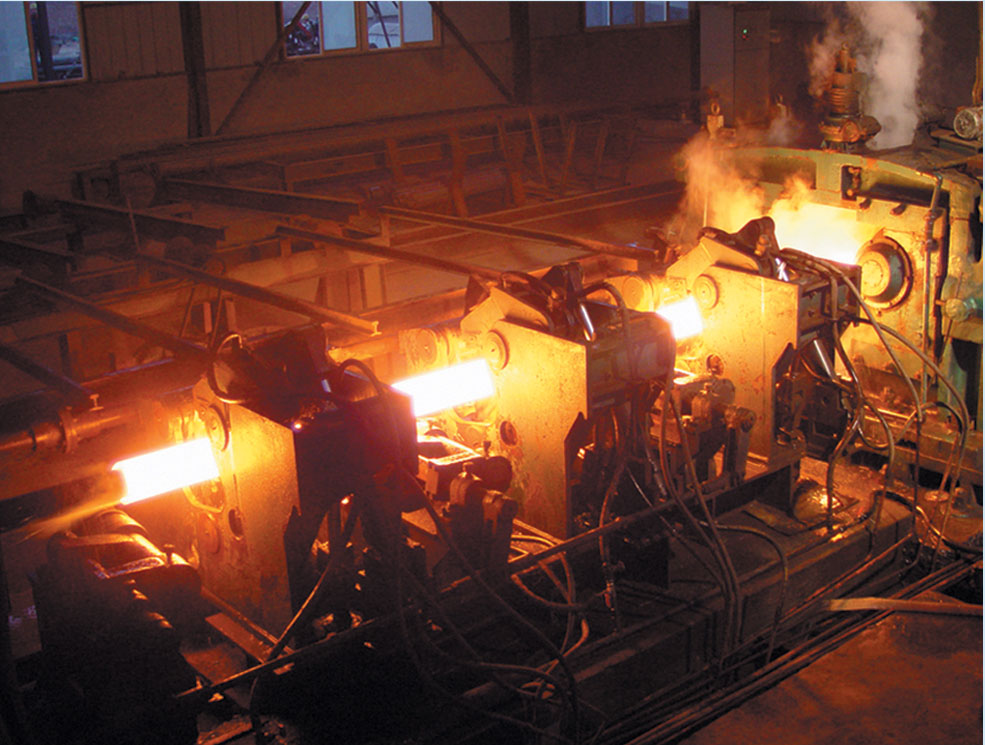
Production of steel pipe is grouped into two general categories: WELDED and SEAMLESS. 
There are many methods of producing steel pipe in current use. However, most of the pipe produced in the United States is made by either the Continuous Weld, the Electric Resistance Weld, the Double Submerged Arc Weld or the Seamless method.